
“How sharper than a serpent’s tooth it is to have a thankless child!”
I remember reading an article in the old Trek fanzine published and then re-printed for a paperback compilation in which writer Russell Bates was required to defend himself on charges of stealing the central idea of the second season episode, “Who Mourns for Adonais?” Unknown to most fans, Bates was a longtime friend of producer Gene L. Coon, and wrote “How Sharper Than a Serpent’s Tooth” as homage to Coon, who had died the previous year. If there are variations on themes present throughout the Star Trek lore, “How Sharper Than a Serpent’s Tooth” hardly qualifies.
One of the more consistent of those themes is the idea of a super-intelligence roaming the cosmos either searching for God, or claiming to be God, and Kukalkan is that creature. The embodiment of Kukalkan appears as a winged serpent with multi-colored feathers. It reminds me of one of the many strange characters that would pop up on The Venture Brothers, a show that spoofed cartoons like these in every episode. I kept thinking the second Kukalkan popped up, Brock Samson would simply jump on it and crush its neck before it had a chance to spout off its platitudes about helping mankind.
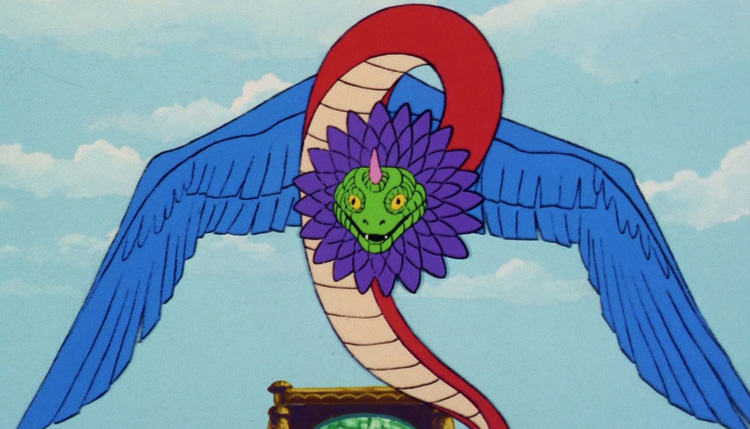
Kukalkan (frustratingly mispronounced as “Koo-kla-Kan” by Shatner all through the episode, and which reminds me of Kukla, Fran and Ollie)) basically captures the Enterprise and puts the ship in a bubble before transporting Kirk, McCoy, Scotty, and Ensign Walking Bear to its ship. That’s right. There is an Ensign Walking Bear who fills the landing party in on the legend of Kukalkan because he’s part Comanche. I got into some heat with a bunch of apologists for calling out Roddenberry’s obvious P.C. pandering to Dakota stereotypes in Star Trek: The Motion Picture, but you’ll note in this episode, Walking Bear is not wearing those ridiculous feathers and headbands.
Kukalkan has a menagerie of dangerous animals in cages (more variations on themes) that have been collected over millenia. Kukalkan tells Kirk about a visit to Earth a long time ago. Kukalkan observed that humans were savages and that nothing has changed, and that they are still considered to be children. We’ve been around this “Prickly Pear” more than a few times in the Animated Series alone, and yes Kirk has to, once again, explain that man is no longer savage and that we have no need for gods, or superior beings. Couldn’t he just draft a memo and “forward to all?” Thankless children, indeed.



 Misadventures in Blissville
Leave a comment