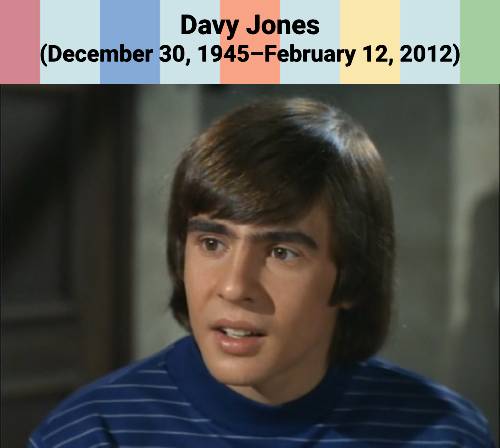
When I started writing the Monkees vs. Macheen blog series back in 2015, I was already too late to write an in memoriam for Davy Jones, who died in 2012. Since then, we also lost James Frawley, Peter Tork, Michael Nesmith, and Bob Rafelson. (Not an exhaustive list, I’m sure.)
Now we’ve reached the 12-year anniversary of his death, I think it’s better late than never to celebrate Jones’ contribution to the show and the band.
Davy was born David Thomas Jones on December 30, 1945 in Manchester, England. He was the only boy in a family of four. His family didn’t have much money—the kids all shared a bedroom and had an outdoor toilet. Davy’s mother died when Davy was only fourteen. After her death, he trained to be a jockey. During his apprenticeship, a talent agent approached him and he chose to pursue a career in entertainment instead.
A few of his career moments:
- His first television appearance was an episode of the British soap opera, Coronation Street.
- He was cast as the Artful Dodger in the musical, Oliver! in London and Broadway productions and was nominated for a Tony in 1963.
- On February 9, 1964, Davy and the Oliver! cast sang “I’ll Do Anything,” on The Ed Sullivan Show—the same night of The Beatles famous performance.
- Davy had a solo record a full year before the Monkees on Colpix records, promoting him as a Fabien-type.
Jones was the first actor cast on The Monkees and at times it seemed that he was treated as the show’s leading man. He was the most traditionally good-looking band member with a leading man’s charm and acting charisma. (He also had the English accent, which, as we know, makes anyone at least 20% hotter than they actually are.) The writers frequently tapped into Davy’s status as “the cute one” who appealed to girls and repeatedly used this as a plot device, even mocking his image in the 1968 feature film, Head.
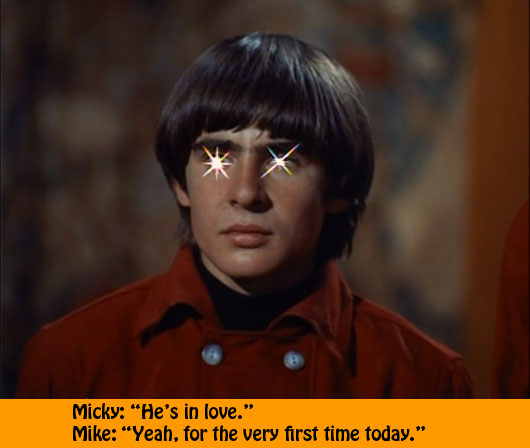
Here are some examples of Davy’s love life getting the band into trouble:
- “Royal Flush” (debut episode)
- “The Chaperone”
- “Here Come the Monkees” (Pilot)
- “Too Many Girls”
- “It’s a Nice Place to Visit”
- “Everywhere a Sheik, Sheik”
- “Hillbilly Honeymoon”
These romantic storylines were generally just clever ways to get all four of them into trouble, or create other humorous situations. The biggest Davy-falling-in-love problem occurred in “Too Many Girls” when a mother and daughter team broke up the Monkees so that the daughter (Fern played by Kelly Jean Peters) could make it in showbiz. Davy and Fern become a tap-dancing, singing duo and enter a talent show. The plot was the perfect device to compel all the other Monkees to participate in the rigged show, posing as various and hilariously untalented wannabes.

The very idea of tearing apart the Monkees came up in “Success Story.” In this episode, Davy tried to prove he was a showbiz success in order to keep his grandfather from dragging him back to England. (I think he was over eighteen and legally an adult but nevermind.)
“Success Story” gave Jones the chance to do some fine acting as he dealt with his guilt over lying to his grandfather and sadness of leaving his bandmates/best friends behind. Jones handled it well. “Success Story” showed he could be counted on to do the serious stuff while the other three provided the comedy.

There were a healthy amount of non-romantic episodes about Davy. In “Don’t Look a Gift Horse in the Mouth,” soft-hearted Davy brought a stray horse into the Monkee pad. He came off as young and childish in this episode, a role usually taken on by Peter. He also refreshed his jockeying skills when he raced a horse.
Jones got the chance to play two characters in “The Prince and the Pauper” when Davy met a Prince with his face. He played the usually charming and confident Davy against the awkward yet arrogant Ludlow.
“Some Like it Lukewarm” was a good Davy-centered, season two episode that dealt with the Monkees struggling to make it as a band. In it, Davy learned how hard it is to be a woman: wearing heels, fighting off inappropriate advances, learning to walk like a “lady” by tying pots and pans to your hips, and so on.

Sometimes Davy’s status as the non-American member came in handy. There were two second-season episodes in which Davy’s British relatives needed his assistance, “The Monkees Race Again” and “The Monkees Mind Their Manor.” He was also fun for quick, comic cut-aways, playing iconic British characters like Watson and Colonel Pickering in “Monkee See, Monkee Die” and “The Chaperone” respectively.

Another favorite episode was “Monkees at the Movies,” in which Davy took a chance at being a teen idol. The show did a lot of showbiz parodies but this was one of the funniest. The band takes a job as film extras. When the egocentric star quits, the others coerce Davy (they draw straws, but it’s rigged) into taking his place. Davy is immediately “spoiled by success” and has to be deflated by his friends. It’s a good thing, since, unlike the star he replaced, Davy could actually sing, act, and dance and probably would have left the band!
Jones’ dancing provided an asset to the show, in comic moments, plot devices, and pure entertainment. In addition to “Too Many Girls” he also employed his soft shoe moves as a gag in “The Spy Who Came in from the Cool” and “The Case of the Missing Monkee” where he did it with a crutch. Davy’s skills saved the day in “Dance, Monkee, Dance” when he infiltrated an evil dance academy. “Daddy’s Song,” his dance number in Head was a showstopper.

Davy was a frequent target of short jokes. In the debut episode, the interview segment launched a recurring gag where Davy is asked to stand up and replies with “I am standing up.” This gag was repeated in “Captain Crocodile” in the television program sequence, and reversed in “Son of a Gypsy” after Davy’s been stretched on a torture rack. Then there’s the “being too short for the peephole gag” that he repeats twice in “Monkees a la Mode.”
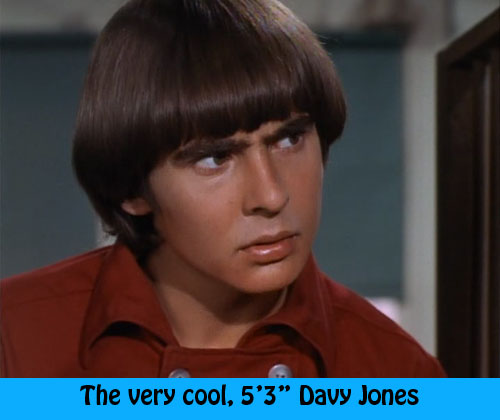
When he wasn’t a lovestruck pup, Davy was self-assured, brave, and a good friend. He portrayed this cool side to his personality in “Your Friendly Neighborhood Kidnappers,” “The Spy Who Came in from the Cool,” and “Monkees a la Mode.” Coolness is an objective concept for which it’s hard to pull out concrete evidence, but mostly I think he exhibits a grounded physical and social confidence when dealing with the other characters—friends or foes.
Sometimes it was overconfidence, such as his eagerness to fight much bigger guys. Take “Monkees a la Cart” when he punches a mob henchman. In “Monkees in the Ring” Davy bravely defended Peter from a large brute, but fell for a con job from an unscrupulous boxing promoter. This is also an example of circumstances that threatened to take Davy away from the Monkees, see “Too Many Girls” and “Success Story” above.
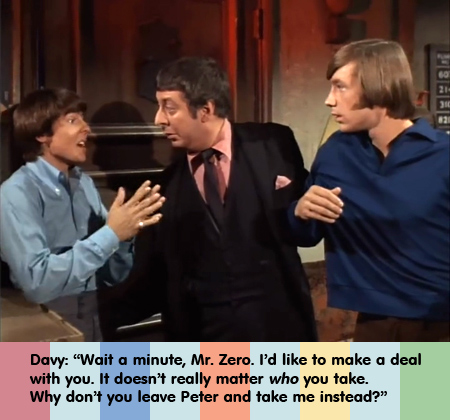
His best and bravest moment was also in defense of Peter. In “The Devil and Peter Tork,” when the devil came to take Peter’s soul, Davy offered himself instead. That’s a friend, right there, willing to suffer eternal torment in place of Peter. I really enjoyed the sentiment in that scene.
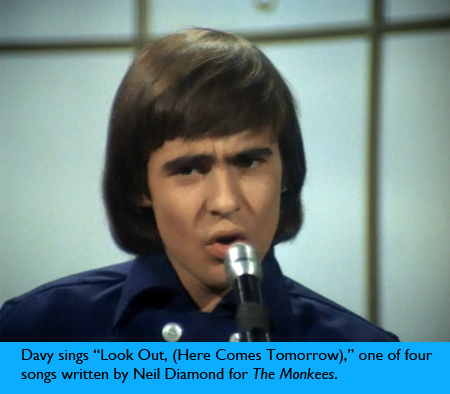
Jones didn’t consider himself one of the musician Monkees; he saw himself as an actor playing a part. He was an important part of the band however, singing on many of the songs. A few of my favorites that included his lead vocals were “Laugh,” “Look Out, Here Comes Tomorrow,” from More of the Monkees and “She Hangs Out” from Pisces, Aquarius, Capricorn & Jones Ltd. “Laugh” is a song that I think of in particular when I get into a glum mood.
He was the lead vocalist on three of the Monkees’ Top 10 Billboard hits
“Daydream Believer” (1967) (spent four weeks at #1)
“A Little Bit Me, A Little Bit You” (1967) reached #2
“Valleri” (1968) reached #3
In the band, usually you would see him playing the tambourine or maracas, but he also learned drums and bass to fill in for Micky or Peter during live shows.
David Jones was a vital part of the Monkees. He died on February 29, 2012 of a heart attack. Apologies for the delay in writing this, Davy. You were an amazing part of my childhood.



 Misadventures in Blissville
Leave a comment