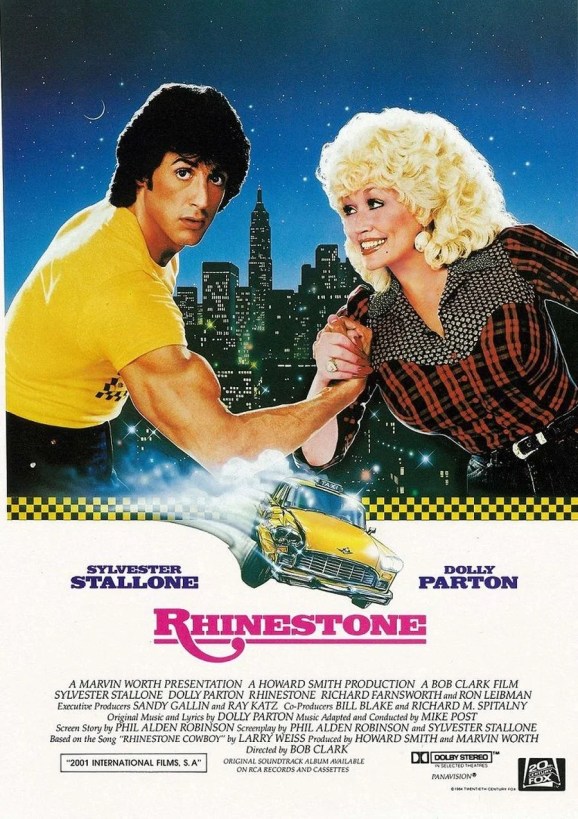
“All right, we’ll go to your place and you can show me your organ. But I’m warning you, it’d best be having music coming out of it.”
A New York City cab driver, who enjoys frightening his foreign fares, runs amok while checking out Dolly Parton’s admirable assets as she makes a bet with her manager, Freddie (Ron Leibman), to turn the next chump she sees into a country music legend, or “rhinestone cowboy,” as the famous song describes it. If she wins the bet, she rips up her contract. If he wins, he gets another five years with her, and she has to go to bed with him. Typical. Well, he does live in Trump Tower.
What impressed me most about Rhinestone was the chemistry between Sly and Dolly. From what I understand, it was Phil Alden Robinson’s script. When he was cast, Stallone re-wrote the script to accommodate his relative lack of skill with the subject of country music. After Dolly breaks bread with Sly’s family, she takes him down to her home in Tennessee where he gets a taste of the local color, the local music, and small-town living. What follows is an intensive course in soul and rhythm, breathing exercises, pork, biscuits, and gravy.
As much as they argue about the function of a biscuit (whether it’s a traditional vehicle for butter or said gravy—I’d say both), they also joust about the form and function of singing, walking, and talking like pure country. Jealous ex, Barnett (Tim Thomerson), also a musician, spars with Stallone and tries to sabotage Dolly’s efforts to make him a rip-roaring success. Looking at Dolly’s birthplace, you’d think everybody living there was either a farmer or musician, or both. I spent some time in Tennessee, but I guess I was in a more suburban area. We didn’t exactly have backwoods, but we definitely had biscuits and gravy.
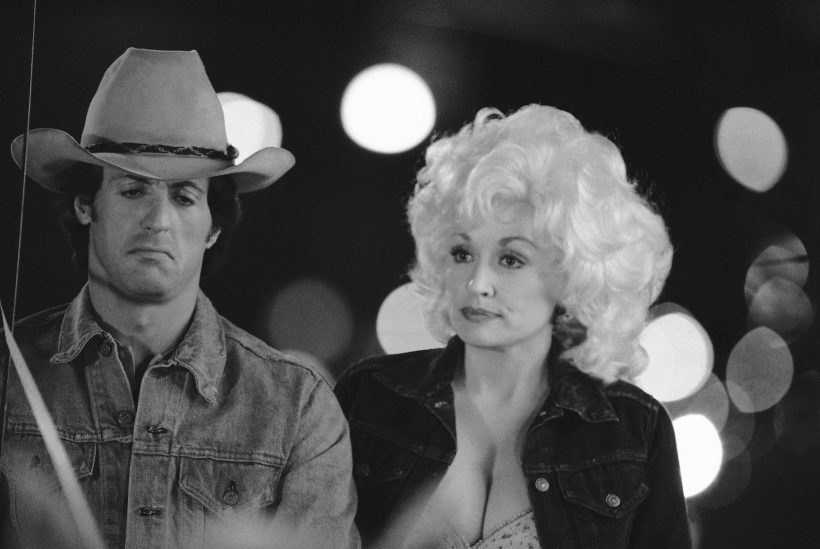
Film snobs howled at Rhinestone, and it was even nominated for seven Razzies, winning two. Is it possible the Razzies even matter these days? Rhinestone flopped at the box office and Robinson distanced himself from the production. It seemed Parton was correct (in her book, Dolly: My Life and Other Unfinished Business) that nobody was interested in seeing Stallone do comedy. Indeed, his other comedies (with the lone exception of Tango & Cash) failed miserably at the box office.
Rhinestone, however, has that inimitable quality of just being pure fun. Dolly is adorable and an incredible talent (I was in awe of the fact that she could play such a sweet guitar with those long fingernails), and Stallone (while not a country musician) acquits himself well. The movie is full of music. Dolly comes from an almost enchanted land of shit-kickers who know their way around a chord and are always entertaining, either to a crowd or for themselves.
The movie was made at the height of New York City country-western craze that started in the late ’70s. Movies like Urban Cowboy and They All Laughed capitalized on the boom. There was even an episode of Bosom Buddies that takes place in a Manhattan bar with a mechanical bull Peter Scolari is goaded into mounting.
My only issue with Rhinestone is what feels like a forced romance between the two leads. She has to fend off the advances of her sleazy manager, as well as her ex-beau. Nearly every male character gawks at her or stares at her breasts, which seems inevitable, but at least Dolly is (and always has been) a good sport about it.
There are also some stereotypes at play. New York goombah meets toothless redneck. Toothless redneck notes that the goombah is, “a little slow.” Ha! Bob Clark (Porky’s, A Christmas Story) is an expert comedy director. I can forgive him for Baby Geniuses 2. Sometimes we don’t quite hit the mark. Rhinestone surprisingly does.
October 21, 2026


Leave a Reply