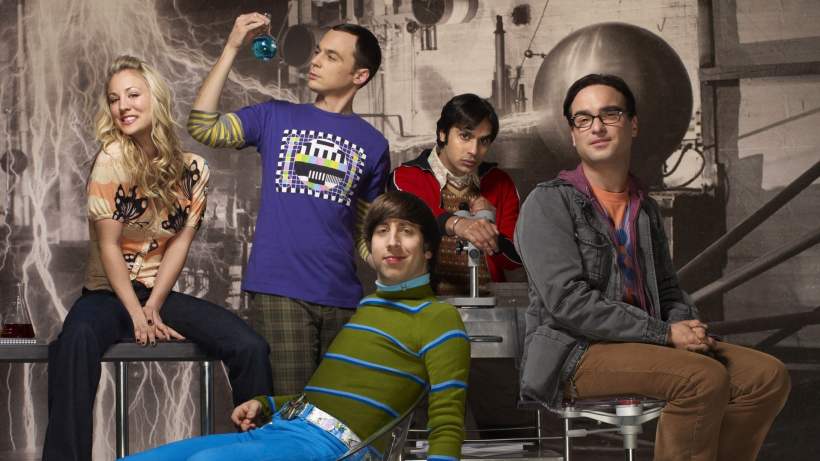
The Big Bang Theory was the last popular situation comedy ever produced in the era of network television. After the show’s final episode premiered, less and less time was devoted to television on “schedule.” Streaming became prevalent as it appealed to audiences looking to control their own viewing habits. At the press of a button, viewers could scroll for content and watch shows at their own leisure.
At its peak in the seventh season, over 20 million viewers tuned in to watch the antics of Sheldon Cooper (Jim Parsons) and his friends. A television series can only go on so long before it becomes less profitable due to rising actor and crew salaries and contractual demands, as well as the tired tropes of modern television series production.
The following is my estimation of the show after way too many viewings. Before anybody accuses me of not having a life, I should note that it took me roughly two hours over the course of four days to put this essay together. So there. Ba-zinga!
The Made-For-TV Renormalization
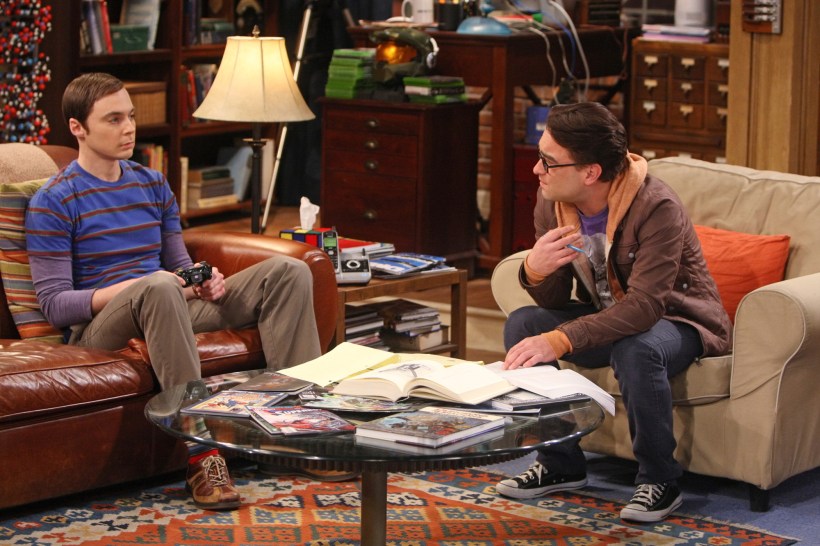
Television shows often present a “cookie-cutter” depiction of relationships with behaviors often relegated to quirks, fetishes, or antipathy. The focus of The Big Bang Theory is the relationship of roommates Leonard (Johnny Galecki) and Sheldon with the introduction of neighbor Penny (Kaley Cuoco) into their lives.
The central location of the show is Leonard and Sheldon’s apartment. Sheldon is depicted as harmless, as well as slightly “autistic,” that is a non-threatening form of autism that has no lasting psychological consequences, yet Sheldon uses his condition to boast of intellectual superiority over everyone he comes across in his field and in adjoining sciences.
The only times he expresses either inadequacy or inferiority is, strangely, when confronted with pop culture figures such as the fictional Professor Proton or the very real Leonard Nimoy. On the one hand, The Big Bang Theory promotes S.T.E.M. but idolizes celebrity above all else. In short, Sheldon’s ego is inconsistent with his comportment.
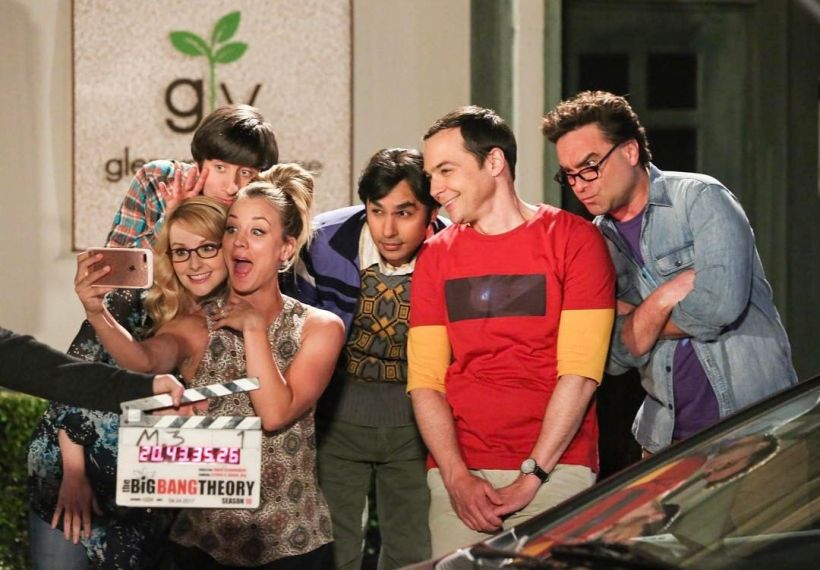
For the first three seasons of The Big Bang Theory, the central (or most interesting) conflict resides mainly with Sheldon and Penny as an “odd couple.” The “odd couple” is the most utilized character dynamic in all of television. Nearly every situation comedy (and more than a few dramas) relies on an “odd couple” aesthetic to provide fish-out-of-water and culture clash narratives.
It isn’t just Felix and Oscar, or Frasier Crane or his dad, or Sam and Diane, or Charlie and Alan, or House and Wilson, or … well, you get the point. Once the conflict moved outside of Sheldon and Penny and grew to contain the supporting characters, the show became less interesting. Indeed, to this day the best episodes are about Sheldon and Penny and their unlikely friendship.
Because of this narrative shift, the writers of the show were required to provide more backstory and then to add girlfriends and eventual wives. Howard (Simon Helberg) was initially depicted as a sexual deviant with a bizarre Freudian attachment to his mother despite living and earning money as an adult for several years. He was telegraphed as a potential sex offender, even going so far as to plant a camera inside a teddy bear he had presented to Penny as a gift.
Raj (Kunal Nayyar) suffered from social anxiety (more on that later). Leonard is the most “normal” of the four friends, therefore the least interesting. Only Sheldon and Penny are written with any degree of interest by the writers. Despite the four male characters (Sheldon, Leonard, Howard, and Raj) being written as friends, there seemed to be a good deal of antipathy between them.
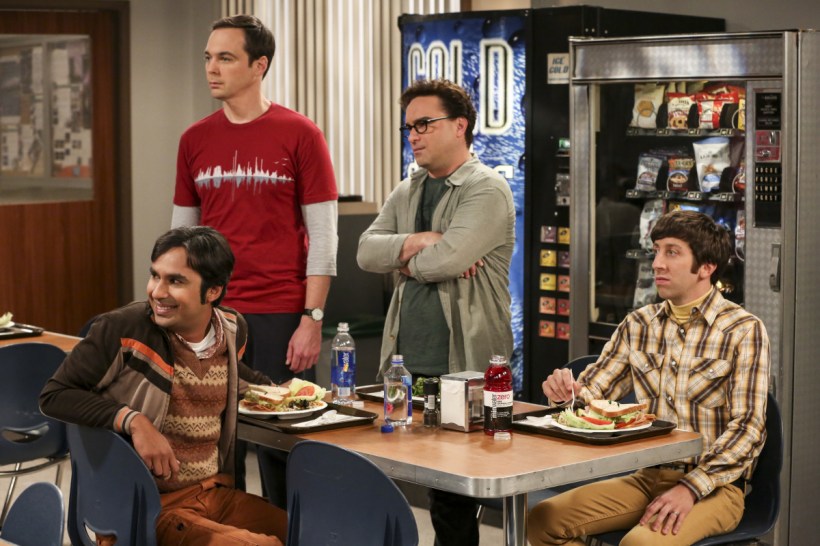
Leonard was threatened by Sheldon’s intelligence (the obvious transference of his hostility for his mother) yet he existed in a co-dependent relationship with Sheldon for fear of having to embrace his inferiority. Howard has unrestrained antipathy for Sheldon (also likely transferring his hostility for his own mother) and considers himself superior to his supposed best friend, Raj, because he can at least communicate with attractive women. Leonard’s mother (Christine Batanski), a noted psychologist, surmises Howard and Raj share a latent homosexual attraction
for one another.
As the show wore on, by the fourth season Howard was dating Bernadette (Melissa Rauch). He was given a story arc involving NASA and the repair of a zero-gravity toilet in space. He married Bernadette and quickly became a father. Raj (with Penny’s help) emerged from his social anxiety shell and dated several women. Leonard, despite his claim that he is awkward around women, went back and forth between dating Penny and a couple of other women (including Raj’s sister, Priya).
Sheldon, oblivious to several women’s advances and obvious attraction to him, started dating Amy Farrah Fowler (Mayim Bialik) after he was matched to her in an online dating profile. By series end, all of them (with the interesting sole exception of Raj) had married and “settled down.” I put that in quotes because they had regressed to adolescent pettiness as the result of their respective relationships.
Amy, as originally written, was a female version of Sheldon. She was quick to correct and/or penalize those who misspoke or overstated any observation. She carried herself in a disturbingly robotic fashion. She had an inflated sense of her own agency and ego. For the first handful of episodes in the fourth season, the other characters detested her.
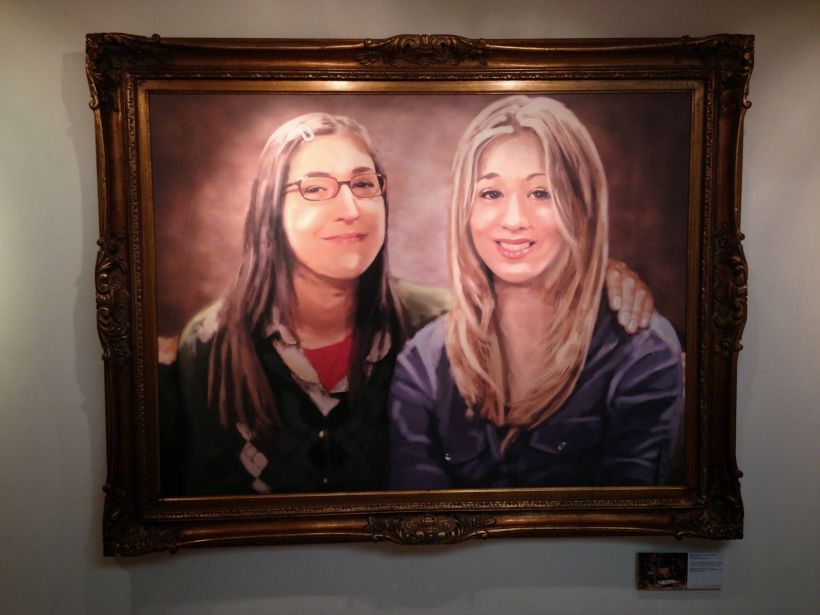
An intriguing and suspicious sea change occurs toward the end of the fourth season when Amy latches on to Penny as an obsessive psychosis develops within the character (for comedic effect, of course). In one of the more disturbing episodes, the fifth season’s “The Rothman Disintegration,” Amy presents Penny with an obnoxiously large painting of the both of them, posed. In the painting, Amy has the smug look of someone proud of the fact that she has a friend in Penny.
Penny, for her part, has a smile plastered over her worried face. Penny’s expression confirms our worst fears about Amy as she appears clueless as to her effect on the people around her. The writers thought they were getting a cheap
laugh, but it wound up being far more disturbing. As the fifth season drags on, Amy’s anxieties are transformed into an obsessive psychosis. Unlike Sheldon, she attempts to control everyone and everything around her rather than believing she is in control of everyone and everything.
Attempts were made to mellow the character in later seasons, but like Bernadette after her marriage to Howard, she still attempts to control every aspect of her partner’s life. She’s demanding, clinging, and manipulative to such a degree she makes people feel bad for not paying enough attention to her, and her supposedly smaller victories are achieved by emotional fiat.
The Men Are Idiots Conceptualization
This is a later development in the storytelling with the introduction of Bernadette and, later, Amy. Making fun of male characters on television is nothing new. It’s been around since at least The Honeymooners or Li’l Abner. Even
though Penny lacks a college education, she is depicted as possessing “street smarts,” which are almost always defined as better than “book smarts.” The show is intent on dealing life-changing lessons to the educated characters (even after they are warned repeatedly by those with book smarts).
This rule is negated when female characters are college educated, as evidenced by early character Leslie Winkle (played by Sara Gilbert) who, while educated, is also sexually promiscuous, but is indemnified of her activities by virtue of being female, thus creating a double standard that glorifies promiscuousness among female characters while damning the male characters for the very same behaviors.
A subcategory of the conceptualization is the “Social Anxiety Peculiarity.” Raj suffers from a devastating form of social anxiety in his preoccupation with women he finds attractive. He cannot verbally communicate with attractive women. The peculiarity becomes a peccadillo, or fetish because Raj seems to be socially available to women he does not find attractive. In the real world, this would be considered a serious mental aberration.
Raj’s condition becomes more troubling when he believes he must drink alcohol in order to communicate with women. It is revealed later there is a placebo effect as he was unaware he was drinking non-alcoholic beer when speaking with Summer Glau. The narrative shift in later seasons elevated the female characters in the show’s
hierarchy.
Penny was a failed actress who worked at The Cheesecake Factory. Bernadette was a grad student working part-time with Penny. Amy was a neuroscientist. By show’s end, Penny becomes a pharmaceutical sales rep working under Bernadette, and Amy shares a Nobel Prize in Physics with Sheldon.
Penny and Bernadette boast of earning more money than their husbands (even though these are their first salaried jobs), and as such, assume traditionally male roles while requiring subservience from their husbands. Humor is also mined from the male characters taking on traditional female roles (such as cooking and cleaning).
Amy demands a level of subservience by keeping Sheldon subtly off balance with her temperament. In one episode, she insists that she and Sheldon move in together to test whether or not they can successfully cohabitate. Almost immediately, Sheldon’s idiosyncrasies irritate Amy and she demands that he adapt to their new surroundings, yet she is unwilling to do this herself. To his (and Penny’s) credit, he never changes.
He learns to live with and possibly understand other people, but he doesn’t change. The fact that the other characters were required to change through the show’s 12-year run is proof that the focus of The Big Bang Theory was on
Sheldon and Penny. The show eventually de-evolves into male versus female sexual politics and discourse marathons. While the female characters sit in living rooms and chat about their partners while drinking large glasses of wine, the male characters engage in “wacky” hijinks.
This is a reversal from earlier seasons wherein concern was expressed for Penny (and Raj’s) heavy drinking. This shift is also mirrored in our current world where heavy drinking (and drug use) is being encouraged as a form of self-empowerment. In short, The Big Bang Theory (over the course of 12 years) started as a fairly unique interpretation of introverts adjusting to a broader world but then became yet another tired variation of Friends.
The Uneducated “Writer” Fragmentation
The Big Bang Theory assumes only nerdy, over-educated men are comic book aficionados and geeks. This couldn’t be further from the truth. The show then course-corrects by having a handful of attractive women serve as surrogate geeks, yet they retain agency and power over the nerdy, over-educated men.
They aren’t just experts in certain kinds of pop culture; they seem to know everything about most recent genre movies and television. Inexplicably, they cannot answer certain questions (such as questions about The Brady Bunch and Sylvester and Tweety) which indicates the only items they bother to study are related to Star Trek and Star Wars (this is quickly changed to reflect DC Comics and related Warner Brothers properties because of the show’s production company).
Regarding product placement (which will be explored in a moment), nearly every piece of visible signage in Stuart’s comic book store is an advertisement for a DC Comics product. DC Comics has been owned by Warner Brothers or a subsidiary or parent company of Warner Brothers since 1972. The Big Bang Theory is produced by
Chuck Lorre for Warner Brothers. Aside from occasional references to Marvel and other companies, the show rarely acknowledges corporate concerns outside of Warners.
Others have made the observation that a good portion of the male characters’ dialogue is a mishmash of pop culture references as well as capsule summaries of physics and metaphysical observations. Occasionally, characters feel the
need to provide exposition for scientific phenomena they have not studied. Each character inhabits an almost purely scientific world. Leonard and Sheldon are physicists. Howard is an engineer. Raj is an astrophysicist.
Because the actors don’t seem to understand their dialogue when making references to physics or engineering (astrophysics is given short shrift), their theories (“super asymmetry,” anyone?) come off as mystical nonsense interpreted by writers who know nothing of physics. Attempts to marshal their forces and collaborate together on projects (such as the “quantum gyroscope” for the Air Force) seem forced and inorganic to the development of the characters and their stories.
The characters are written to be completely brilliant on all subjects even though we know this is not possible. We’re all very good at one thing, for the most part, and fair on other subjects, but none of us know everything about everything. An example of this is when Sheldon uses too many words to explain the difference between a car key and an apartment door key, or when Sheldon uses physics-sounding words to explain the usefulness of adhesive strips in a bathtub.
This level of intelligence would be more justified if the actors knew what they were talking about. Instead, they just sound like they’re rattling off dialogue they committed to memory just moments before rolling the camera. Explanations of thought experiments fair just as worse (examples: Schrödinger’s cat and positive behavior reinforcement) and read as though they were cut and pasted from the Wikipedia.
The Product Placement Exploration
It isn’t a poorly kept secret that advertisers finance network television shows. Networks use tracking sources such as Nielsen ratings to meter the success or failure of a television series. If those ratings are high (on average, in 2024,
around 5 to 10 million viewers, down by half after The Big Bang Theory’s final episode premiered May 16, 2019), the network can charge more money per 30 second spot during commercial breaks.
A show’s popularity makes money for its network. Shows with lower ratings are either cancelled, moved around in a network’s schedule, or given less money for production budgets to adjust for those losses. It also isn’t a poorly-
kept secret that the sole purpose of a television show is to sell products. In reruns on TBS, there are constant commercial breaks selling the same products over and over (such as Burger King, Haribou Gummie Bears, Progressive Auto Insurance, PayPal, and assorted beer products and cars).
Every television network (and several streaming services) uses their shows to sell products. It’s interesting because it’s all based in financial theory. The theory is that if you produce a television commercial that sells a product,
someone may buy that product on the basis of that commercial. The reason that this is a “theory” is because it’s never been proven. Advertising is a multi-billion-dollar industry and it’s all based on a theory.
There are also subliminal advertisements (naked women in ice cubes in beverages, the “MoM” initials in the Wendy’s logo, etc.). There are advertisements everywhere: on the sides of buses, on top of taxis, on the Internet, written in the sky, before, during, and after YouTube videos, in movie theaters, product placement in movies and television shows.
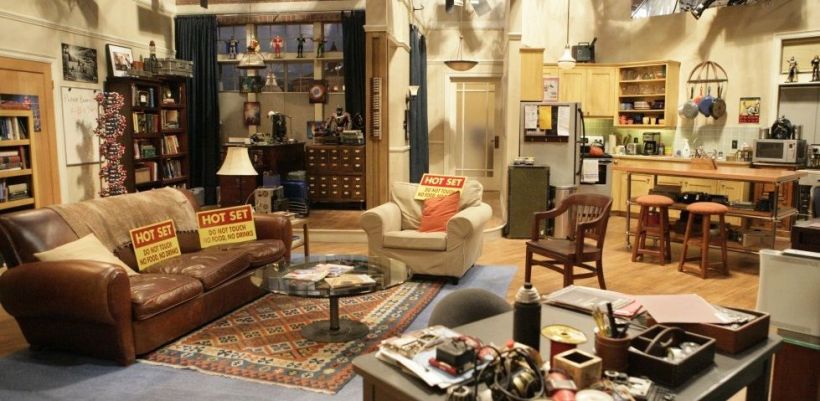
The Big Bang Theory takes it one step further. Leonard and Sheldon’s apartment is designed to be a shrine to products. Conveniently, both characters’ obsession with pop culture allows the show’s set decorators to arrange the apartment with furniture, props, and displays that sell products. Nearly every camera angle used in the apartment reveals some degree of pop culture business. Even with all the knick-knacks, collectibles, and gimcracks on display, there is nary any dust or accumulated grit, and we never see anyone cleaning.
The bizarre layout of the 2-bedroom apartment boasts Star Wars action figures, Batman and Superman dolls, bobbleheads, framed “object d’art” movie posters, lava lamps, re-purposed foot lockers, the famous helix sculpture (for sale from Indigo Instruments!), chess sets, it goes on. In addition, Sheldon has additional space inside a storage room he has rented because he’s a hoarder at heart. There is a gorgeous kitchen area with a chef’s stove that is used only a handful of times during the show’s run as the characters mainly eat take-out.
Because the products are placed in the background, the effect is subtle, but it is present nonetheless. The most suspicious of these props is the Longclaw “Winter is Coming” sword display from Game of Thrones, produced by Valyrian Steel Shop (available now!). Game of Thrones, produced by Warner Brothers, premiered April 17, 2011, four years after The Big Bang Theory. In the fourth season, the sword display appeared in apartment 4A.
The display was then moved across the hall to the apartment Sheldon shared with Amy (Why didn’t Leonard simply move in with Penny after they married? Sheldon is/was the primary tenant of 4A as well as the star of the series). I’m willing to bet every stick of furniture in Apartment 4A is available for sale as well. The Big Bang Theory paid off in enormous dividends as a product delivery device disguised as a television sitcom.
The Laugh Track Constant
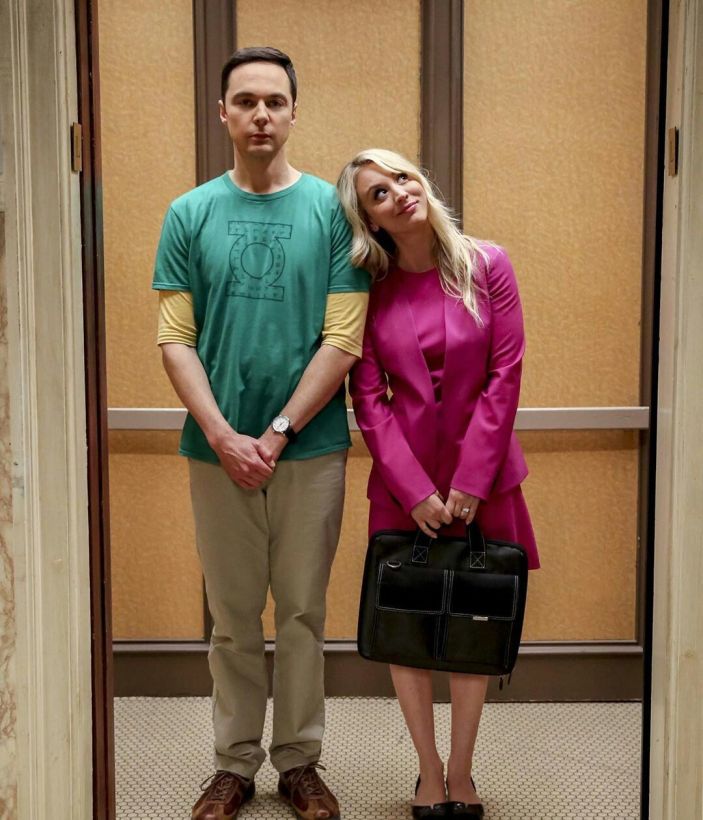
By this point, we’ve all seen those rather clever (if disturbing) videos of The Big Bang Theory with the “laugh track” removed. While turning a situation comedy into a jingoist serio-drama, it also sheds light on a few uncomfortable
realities. The Big Bang Theory can (almost too easily) be dismissed as drama, and the sound mixers employed on the show can’t identify the jokes, so they simply put a laugh after nearly line of spoken dialogue.
It devolves into a formula comprised of a “set-up” line (usually expository), a response, a joke after the response (chuckle), another “joke” building on that joke (laughter), another joke underscoring the ridiculousness of the previous joke (big laugh), and then a small aside denouement (even bigger laugh). It goes on like that at an average of five times per episode. As more characters are added to later episodes, the average goes up to about ten, and the delivery is faster to make more room for the artificial laughs. This formula was also used in later seasons of Friends.
Even with the tired tropes of a sitcom that was on television for way too long, The Big Bang Theory was an interesting reflection of the changes in our culture over the course of those 12 years. It was also a reminder (as a possible psychological experiment) that some things don’t change. If we never get back to the era when network television ruled the airwaves, at least we’ll be able to appreciate the show for the museum piece it was. Cue the canned laughter.
October 27-29, 2024
November 3, 2024


Leave a Reply