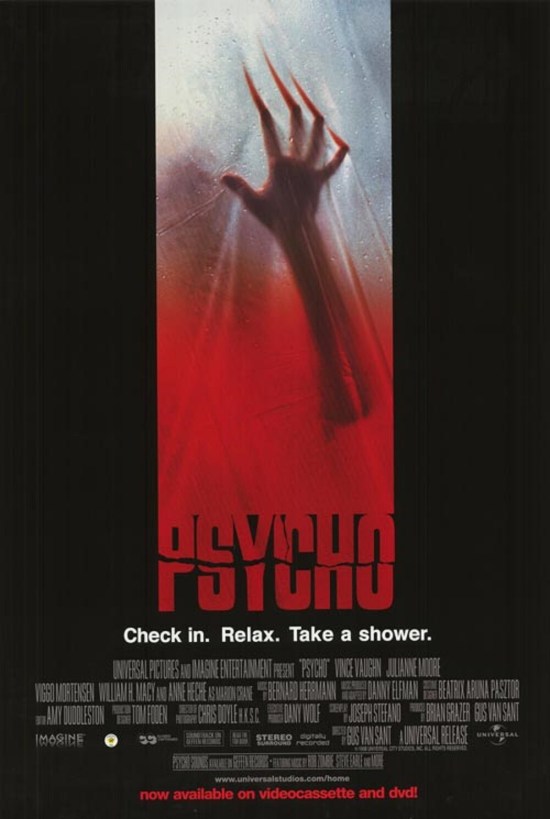
“Let me grab my Walkman.”
I wrote a review of the 1998 shot-for-shot remake of Psycho way back in 2000, but I might’ve misplaced it. I don’t know if my thoughts on the subject were as cogent as they could be today, but I do know I’m a slightly different person these days (only slightly…only slightly). I might’ve asked the same questions I’ll ask right here.
1.) Why did they do this?
2.) What were they trying to accomplish?
3.) Did they think they could make a better version of this?
I remember renting the movie (on VHS!). I said I wasn’t going to do it, but I did it. I think everything else was out that Friday. There were some items that infuriated me. The casting of Vince Vaughn was the king of those particular woes. The script’s timing, even though it was a copy/paste job by the original writer, Joseph Stefano, as well as being five minutes shorter than the original, seemed slower.
The characterizations were off. There are some unusual stereotypes on display. In the musical stings and interludes of Danny Elfman’s adaptation of Bernard Hermann’s score, director Gus Van Sant flashes on dream-like imagery that cuts together like a Nine Inch Nails music video. Ah, the ’90s.
There were some interesting camera tricks; angles and smooth tracking shots Hitchcock could never accomplish on his limited budget. The original movie was budgeted at around $800,000. Adjusted for inflation in 1998, the budget would be $4.5 million. The 1998 remake’s budget was $25 million.
Some compromises could be made for the movie being photographed in color, and the visual effects trickery as well as rising union and actor salary costs, but if anybody wonders why things cost more these days, it isn’t because of inflation and the value of a dollar.
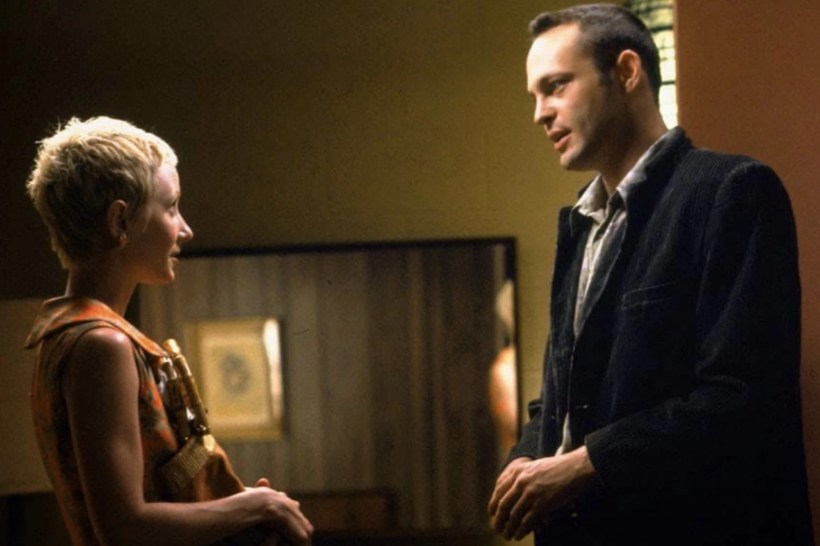
Anne Heche is Marion Crane. She absconds with a cash deposit meant for the bank so she can bring it to her boyfriend, Sam (Viggo Mortensen), and presumably start a new life. She stops at the Bates Motel, meets the eccentric young man, Norman (Vaughn), who runs the place for his seemingly abusive mother. She takes a shower and the rest is history.
Julianne Moore plays her temperamental sister, Lila. William H. Macy plays the doomed private dick, Arbogast. Generally, I don’t have a problem with the casting, just the bizarre motivations of some characters. When Sam wants to go check out the motel after Arbogast fails to report in, Lila goes along, but first, she has to grab her Walkman. Don’t expect her to be a gifted conversationalist on a road trip.
Even if you haven’t seen the movie, you would easily think Vaughn to be terrible casting for the part of Norman Bates. It’s along the lines of Chloe Grace Moretz as Carrie White in that 2013 remake. Nothing on Moretz. She’s a fine actress, but she’s all wrong for the part. Vaughn is too tall, conventionally handsome, and athletic to be the neurotic, insecure, emotionally dependent personality that haunts Norman. He also doesn’t look comfortable playing this part. Heche and the rest of the cast are fine, but it’s strange watching what amounts to a period piece that is also a remake of a period piece.
The gimmick of the shot-for-shot remake, while a curious film school exercise was dreamt up by Van Sant and Imagine Entertainment because they surmised younger audiences would have no knowledge of the original, even if it is iconic. In the documentary on the DVD release, several kids of college age reveal they’ve never seen Psycho.
To that end, the movie’s purpose is noble as a failed experiment. Like I said there are some interesting choices being made here. I like the use of rich, vibrant color to emphasize not only the blood and gore, but Heche’s eye-catching wardrobe of dresses with bold color choices. Christopher Doyle’s photography is striking in more ways than one.
There’s also the potential for new ideas to creep in. Good ideas. Indeed, the movie is strongest when Van Sant deviates from Hitchcock. There’s a world here, in 1998, we can understand far more than 1960. It’s intriguing that I understand Heche a little more than Janet Leigh, because she’s a little closer to my sensibilities. She’s the best part of the movie, and yet she was nominated for a Razzie, while conversely being nominated for a Saturn Award.
There are no new revelations in this remake. I think the best part is the closing credits where we see an extended version of Crane’s car being removed from the swamp and then the resulting gathering of forensic evidence. The sequence brings to the foreground the consequences of what Norman has done. I think Van Sant should’ve made his own movie. It would’ve been much better than this.
October 28, 2026


Leave a Reply