“You wanna hurt me? Go right ahead if it makes you feel any better. I’m an easy target. Yeah, you’re right, I talk too much. I also listen too much. I could be a cold-hearted cynic like you… but I don’t like to hurt people’s feelings. Well, you think what you want about me; I’m not changing. I like… I like me. My wife likes me. My customers like me. ‘Cause I’m the real article. What you see is what you get.”
“Those aren’t pillows!”
Was it me? Did I feel disaffected after years of John Hughes movies that I couldn’t embrace Planes, Trains and Automobiles? At that point, I wasn’t completely aware of Hughes’ history. I knew that he wrote Vacation and Class Reunion for National Lampoon, Mr. Mom, and Nate and Hayes but the three-picture deal with Universal yielded three incredible (for different reasons) movies: Sixteen Candles, The Breakfast Club, and Weird Science. Hughes had ups and downs with critics who enjoyed his serious tone, but howled at his goofy comedies.
He founded Hughes Entertainment and put together a multi-picture deal with Paramount Pictures. His first film, Ferris Bueller’s Day Off, was a rip-roaring success, earning $70 million on a $5 million budget. He branched off as a writer-director into adult territory, while continuing to write scripts that catered to the teenage market. He wrote Pretty in Pink and Some Kind of Wonderful for director Howard Deutch, but directed Planes, Trains and Automobiles and She’s Having a Baby. This was all part of the Paramount deal and Hughes’ free agency.
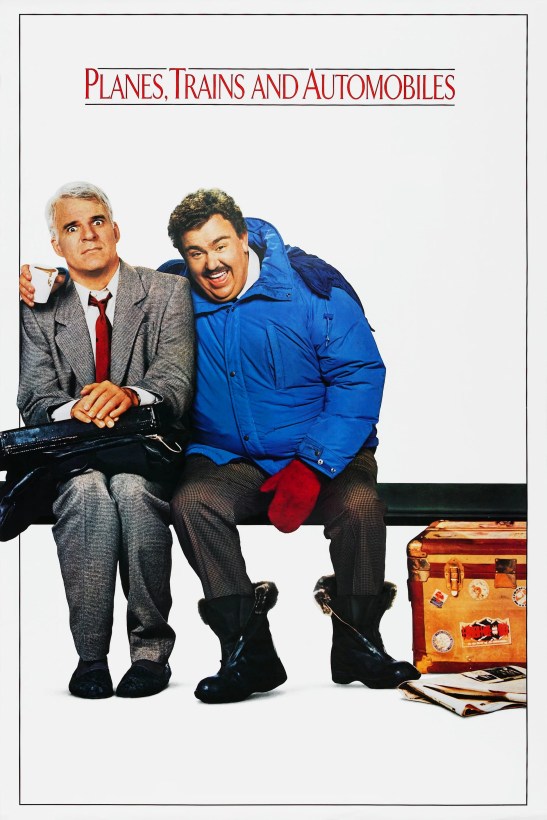
Hughes had effectively transitioned into movies for adults. He would transition further down the road into (much to the horror of Gen-X) crowd-pleasing movies for the whole family. For the first time (or so we assumed) John Hughes wasn’t speaking to us. He was speaking to everyone. There was a big, thick movie magazine with a high-quality glossy advertisement for Hughes Entertainment and Planes, Trains and Automobiles with a wide-smiling John Candy and a worried Steve Martin.
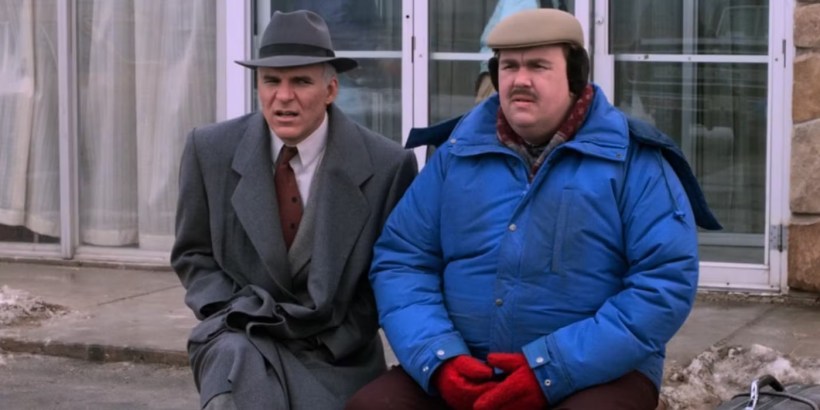
Odd, the movie was given an extended weekend holiday release, premiering the day before Thanksgiving in 1985 and collecting five days’ worth of box-office receipts. This was, most likely, the movie’s biggest haul. It would go on to make $50 million on a $15 million budget. Not a flop, but certainly not a rip-roaring success. Cast against type, Candy’s obnoxious lout, Del Griffith, seems constructed to put Martin’s strait-laced Neal Page through the paces in living-hell scenarios as the two travel together from New York City to Chicago.
I’m reminded of Neighbors and The Great Outdoors. There are bizarre setbacks and diversions. Martin loses a car and most of his money, and all he wants to do is to get home in time for Thanksgiving with his family. For his part, you can’t hate Del because he’s a good-natured guy and his heart is in the right place. If anything, Neal is a bit of a load; angry and tired most of the movie. This was a rare departure for Martin, playing an ostensibly unlikeable character.
Early Martin characters veered from the naive to the lovelorn; lonely people insecure in their relationships. It was only rarely he would go back to that character with performances in Novocaine and Shopgirl. The Steve Martin we know today would play the “straight-man” to another comedian’s antics (Bowfinger) similar to Neal Page, and a later renaissance would see Martin in interesting dramatic roles. In the last two years, he has appeared in four documentaries: one about himself, one about John Candy, one about Lorne Michaels, and one about Martin Short.
For John Candy, leading man status didn’t yield much in the way of success. Candy was always a capable supporting performer. Roles in movies such as Delirious, Uncle Buck, and Only the Lonely didn’t appeal to mass audiences. In Planes, Trains and Automobiles, Martin and Candy play off each other beautifully. It’s a movie I appreciate much more now than I did when I was a kid. This isn’t just a movie about two people making each other crazy. There’s an undercurrent of loneliness and despair, but there’s also heart, as well as being thankful for what we have.
Happy Thanksgiving, 2026!
November 14-16, 2026


Leave a Reply